
A Cross-Functional AI Agent Needs a Handoff Map, Not Just a Prompt
A practical way for US teams to coordinate sales, operations, finance, and document preparation without losing ownership of decisions.
Start with the work between teams
Even a two-person agency may divide a signing handoff across several roles. One person may supply commercial details and confirm a delivery date; another may check billing. An AI agent can help collect those inputs, but a broad instruction to “get the agreement ready” hides who owns each decision. Map the handoffs, required inputs, and people authorized to resolve exceptions. One person can hold more than one role; the decisions still need names.
Choose one repeatable workflow for a pilot, such as assembling an approved order packet. Define its starting event, the source of each field, and its stopping point. The agent might request missing information and prepare a checklist; it should not infer a disputed term or send a document simply because all fields appear filled. NIST’s AI Risk Management Framework calls for a documented application scope and defined processes for human oversight.
Give each team a clear decision owner
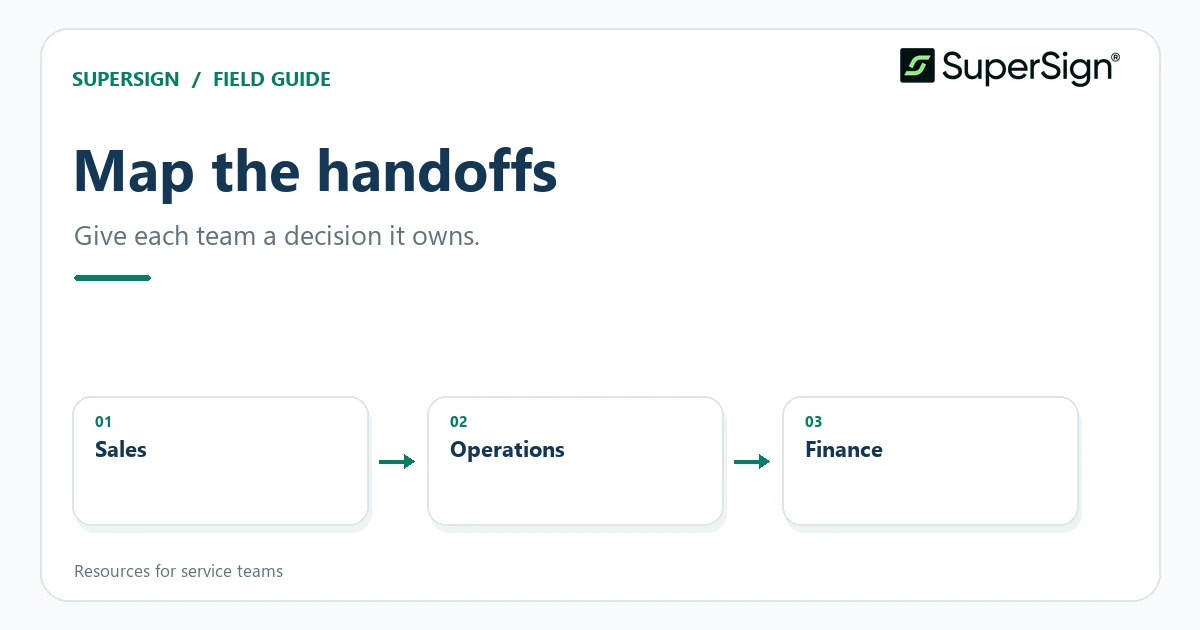
A useful handoff map separates information gathering from approval. Sales confirms the customer-facing request, operations checks whether the proposed work can be delivered, and finance verifies the internal billing setup. One person might hold several of these roles in a small firm. What matters is that a reviewer can tell who owns a question and that the agent cannot turn silence into an assumed yes.
The agent’s task list can make these lanes visible: “awaiting operations confirmation” is more useful than “processing.” If two teams provide conflicting values, preserve both and route the conflict to a named owner. Avoid asking another agent to settle the disagreement merely by generating a more confident answer. A cross-functional workflow succeeds when unresolved decisions remain visible until a responsible person resolves them.
Make the handoff a structured record
For each transfer, record the document identifier, requested action, source of the relevant information, current owner, and next checkpoint. A concise handoff record lets the receiving team act without reconstructing a conversation from chat messages. It also makes it easier to distinguish a missing attachment from a missing business decision. Keep the record focused on what the next person needs rather than copying every source document into every notification.
Use explicit states such as ready for review, returned for clarification, approved for preparation, and held. State names should describe what has happened, not what the agent predicts will happen. If an agent can update a state, decide whether that update is informational or whether it unlocks another action. OWASP warns that unnecessary tools, permissions, and autonomy can turn an unexpected agent output into an unintended downstream action.
Pilot the exceptions, not only the happy path
Test the workflow with a clean packet, then with deliberately awkward examples: two different customer names, an obsolete attachment, an unavailable approver, and an email that asks the agent to skip a checkpoint. Observe where the work stops and who receives the question. A useful pilot measures whether people can understand and resolve exceptions, not merely whether an agent can complete an uncomplicated demonstration.
After the pilot, ask each participating team which prompts were useful, which notifications created noise, and which decisions lacked a clear owner. Adjust the map before widening access. Keep a manual route for work that does not fit the pilot’s scope. The aim is a dependable division of labor: agents organize and surface the work, while the relevant people retain responsibility for consequential business choices. When the next step is a signature request, the handoff should still name the document version and the person who can approve its release.
Sources and further reading
Related resource: Service Agreements and SOWs: A Document Checklist for Service Firms
The workflow is illustrative, makes no SuperSign product claims, and is not legal advice.